

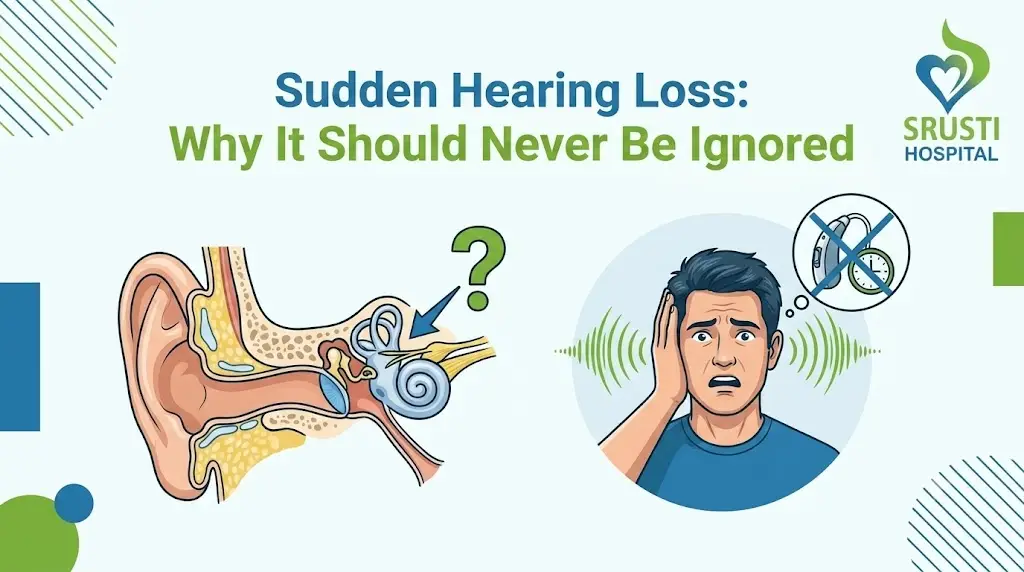
Sudden hearing loss can happen unexpectedly and may affect one or both ears. A person may notice that sounds suddenly seem quieter, speech becomes difficult to understand, or one ear feels blocked.
Although some hearing changes may be caused by common problems such as earwax or an ear infection, sudden hearing loss can sometimes be linked to an inner-ear problem called sudden sensorineural hearing loss (SSNHL).
Because some forms of sudden hearing loss need prompt medical assessment and treatment, it should not simply be assumed to be earwax, congestion, or a temporary blockage. Early evaluation may improve the chance of hearing recovery.
Understanding the warning signs, possible causes, diagnosis, and treatment options can help people seek appropriate care without unnecessary delay.
What Is Sudden Hearing Loss?
Sudden hearing loss means that hearing decreases rapidly, usually over a short period. Sudden sensorineural hearing loss is a specific type that involves the inner ear or the hearing pathway.
SSNHL commonly affects one ear. It may develop all at once or become noticeable over a few days.
The condition may be noticed when:
- One ear suddenly sounds quieter
- Speech becomes difficult to understand
- Sounds seem muffled
- There is a feeling of fullness in the ear
- Ringing or buzzing develops
- Dizziness or imbalance occurs
According to the National Institute on Deafness and Other Communication Disorders, sudden sensorineural hearing loss should be treated as a medical emergency because delaying assessment and treatment can reduce the effectiveness of treatment when treatment is appropriate.
Why Should Sudden Hearing Loss Never Be Ignored?
Sudden hearing loss can have several possible causes. Some are temporary and treatable, while others may affect the inner ear or hearing nerve.
For example, hearing may suddenly seem reduced because of earwax or fluid in the middle ear. However, a similar sensation can occur with sensorineural hearing loss.
Therefore, it is not always possible to identify the cause simply by how the ear feels.
A doctor can examine the ear and arrange a hearing test when needed. This helps distinguish a blockage or middle-ear problem from an inner-ear hearing loss.
Common Signs of Sudden Hearing Loss
Sudden hearing loss may be accompanied by different symptoms.
Common signs include:
- Sudden reduction in hearing
- Hearing loss mainly in one ear
- Muffled or unclear sounds
- Difficulty understanding conversations
- Ear fullness or pressure
- Ringing or buzzing in the ear
- Dizziness or imbalance
Some people may notice the problem immediately after waking up. Others may discover it while using a telephone or listening to someone speak.
Because symptoms can vary, sudden changes in hearing should be assessed promptly.
Sudden Hearing Loss in One Ear
Sudden hearing loss often affects only one ear.
A person may notice that one side sounds quieter while the other ear appears normal. This can make the problem easy to overlook, particularly in a noisy environment.
However, sudden hearing loss in one ear still requires medical evaluation.
In some cases, doctors may recommend further investigations to look for problems affecting the hearing nerve or structures behind the inner ear. MRI or other appropriate tests may be considered depending on the clinical situation.
Ear Fullness and Hearing Loss
A blocked or full sensation in the ear does not always mean that earwax is responsible.
Sudden sensorineural hearing loss can also cause a feeling of fullness or pressure in the affected ear.
Therefore, repeatedly trying to clean the ear or waiting for the sensation to disappear may delay proper evaluation.
If ear fullness appears together with sudden hearing loss, ringing, or dizziness, medical assessment is particularly important.
Ringing in the Ear Along With Hearing Loss
Tinnitus means hearing a sound such as ringing, buzzing, humming, or whistling when there is no external source.
Tinnitus can occur for many reasons. However, when ringing develops suddenly along with a noticeable reduction in hearing, it should not be ignored.
A hearing assessment can help determine whether the symptoms are associated with sensorineural hearing loss or another ear problem.
Dizziness and Sudden Hearing Loss
Some people with sudden hearing loss may also experience dizziness or imbalance.
This happens because the inner ear is involved in both hearing and balance.
However, dizziness can have many different causes. Therefore, the combination of sudden hearing loss and dizziness should be assessed by a healthcare professional rather than treated as a simple ear blockage.
What Causes Sudden Hearing Loss?
There may be several possible causes of sudden hearing loss.
These can include:
- Inner-ear disorders
- Viral or other infections
- Head or ear trauma
- Autoimmune conditions
- Certain medicines that can affect hearing
- Blood circulation problems
- Neurological conditions
- Ménière’s disease
- Problems affecting the hearing nerve
However, in many cases of sudden sensorineural hearing loss, an exact cause cannot be identified.
Therefore, medical evaluation is important even when there is no obvious reason for the hearing change.
Can Earwax Cause Sudden Hearing Loss?
Yes, earwax can cause conductive hearing loss and make sounds seem blocked or muffled.
However, earwax is not the only possible explanation for sudden hearing changes.
This is why people should avoid assuming that a sudden loss of hearing is simply due to wax.
A healthcare professional can examine the ear and determine whether an obstruction is present. If necessary, a hearing test can then help identify the type and severity of hearing loss.
How Is Sudden Hearing Loss Diagnosed?
Doctors usually begin with a detailed medical history and examination of the ear.
The evaluation may include:
- Examination of the ear canal and eardrum
- Hearing assessment
- Pure-tone audiometry
- Additional hearing tests when required
- Imaging such as MRI in selected cases
- Other investigations depending on the suspected cause
Audiometry is particularly important because it can confirm the type and degree of hearing loss.
The AAO-HNS guideline recommends obtaining or referring for audiometry as soon as possible, and within 14 days of symptom onset, to confirm sudden sensorineural hearing loss.
Importance of a Hearing Test
A hearing test provides more information than simply asking whether a person can hear.
Pure-tone audiometry measures how well a person hears different sound frequencies and helps determine the degree and type of hearing loss.
As a result, it can help doctors distinguish sensorineural hearing loss from conductive hearing loss.
Because treatment decisions may depend on the type and timing of hearing loss, timely hearing assessment is important.

When Should You See a Doctor?
You should seek medical evaluation promptly if you notice:
- Sudden hearing loss in one or both ears
- Hearing that becomes noticeably weaker within hours or days
- Sudden hearing loss with ringing in the ear
- Sudden hearing loss with dizziness
- A new feeling of fullness together with reduced hearing
Do not wait several days to see whether the hearing returns on its own.
Some people may recover part or all of their hearing naturally, often within the first one to two weeks. However, delaying diagnosis and treatment can reduce the effectiveness of treatment when it is indicated.
Treatment for Sudden Hearing Loss
Treatment depends on the cause, type, severity, and timing of the hearing loss.
For sudden sensorineural hearing loss, corticosteroids are commonly considered as an initial treatment. They may be given orally or, in suitable cases, directly into the middle ear through an intratympanic injection.
The AAO-HNS guideline states that corticosteroids may be offered as initial therapy within two weeks of symptom onset. For people who do not recover completely, intratympanic steroid treatment may be offered as salvage therapy within two to six weeks after onset.
Treatment should always be decided by a qualified doctor because steroids are not suitable for everyone and can have important side effects or contraindications.
Why Timing Matters in Treatment
Time can be an important factor in sudden sensorineural hearing loss.
The NIDCD notes that steroids should be used as soon as possible when appropriate, and treatment delayed beyond two to four weeks is less likely to reverse or reduce permanent hearing loss.
Therefore, early medical assessment gives the doctor more opportunity to identify the cause and discuss suitable treatment options.
Can Sudden Hearing Loss Be Treated Completely?
Recovery varies from person to person.
Some individuals may recover some or all of their hearing, while others may have lasting hearing loss.
Recovery can depend on factors such as:
- The severity of hearing loss
- The type of hearing loss
- How quickly treatment begins
- The underlying cause
- The individual’s overall health
Therefore, it is not possible to predict recovery accurately without a proper examination and hearing assessment.
What Happens If Hearing Does Not Recover?
If hearing loss remains after treatment, additional support may be available.
Depending on the degree of hearing loss, doctors and hearing specialists may discuss:
- Hearing aids
- Audiological rehabilitation
- Communication strategies
- Other hearing-support options
- Cochlear implantation in selected cases of severe hearing loss
The appropriate option depends on the person’s hearing level, symptoms, and overall condition.
Can Sudden Hearing Loss Be Prevented?
Not every case of sudden sensorineural hearing loss can be prevented because many cases do not have an identifiable cause.
However, people can still protect their overall hearing health by:
- Avoiding prolonged exposure to very loud sounds
- Using hearing protection in noisy environments
- Following safe listening practices
- Taking medicines only as prescribed
- Managing health conditions that may affect overall health
- Seeking medical attention for sudden changes in hearing
Most importantly, prevention should not replace prompt medical care when sudden hearing loss occurs.
What Should You Do If Hearing Suddenly Drops?
If you suddenly notice that one ear cannot hear normally, take the change seriously.
A practical approach is to:
- Seek medical evaluation promptly
- Avoid assuming that the problem is only earwax
- Avoid inserting objects into the ear
- Arrange a hearing assessment when advised
- Follow the treatment plan provided by your doctor
- Attend recommended follow-up appointments
Prompt evaluation can help determine whether the hearing loss is caused by a simple blockage or a condition requiring urgent treatment.
When Is Sudden Hearing Loss an Emergency?
Sudden hearing loss itself deserves prompt medical attention, particularly when it develops rapidly.
However, emergency assessment is especially important if hearing loss occurs together with symptoms such as:
- Severe dizziness
- New neurological symptoms
- Facial weakness
- Severe headache
- Difficulty speaking
- Weakness or numbness
- Loss of balance
These symptoms can have causes that require urgent evaluation.
Importance of Follow-Up
Follow-up is important even after treatment has started.
Doctors may recommend repeat hearing tests to assess recovery and determine whether additional treatment or hearing rehabilitation is needed.
The AAO-HNS guideline recommends follow-up audiometric evaluation after treatment and again within six months of completing treatment.
Regular follow-up also allows doctors to monitor persistent hearing loss or tinnitus and provide appropriate support.
Common Mistakes to Avoid
When sudden hearing loss occurs, people may make several common mistakes.
These include:
- Waiting for the hearing to return on its own
- Assuming it is caused by earwax
- Using ear drops without medical advice
- Putting cotton buds or other objects into the ear
- Delaying a hearing test
- Taking medicines without professional guidance
Although some causes of hearing loss are minor, others require timely treatment.
Therefore, it is safer to have sudden hearing changes evaluated promptly.
Living With Hearing Loss
If hearing does not fully return, people can still benefit from appropriate treatment and rehabilitation.
Helpful steps may include:
- Using recommended hearing devices
- Attending hearing assessments
- Learning communication strategies
- Reducing background noise during conversations
- Informing family members about communication needs
- Following regular ENT and audiology appointments
With appropriate support, many people can adapt to changes in hearing and maintain their daily communication and quality of life.
When Should You Consult an ENT Specialist?
You should consult an ENT specialist if you experience sudden or unexplained hearing loss, particularly when it affects one ear.
An ENT specialist can examine the ear, assess the hearing pathway, recommend appropriate hearing tests, and determine whether further investigation or treatment is required.
Because sudden sensorineural hearing loss can be time-sensitive, seeking care early is important.
Book Your Consultation
Sudden hearing loss should never be dismissed as simple ear blockage or temporary congestion. Although some causes may be minor, sudden sensorineural hearing loss can require prompt assessment and treatment.
If you notice a sudden change in hearing, especially in one ear, seek medical attention as soon as possible.
Early evaluation can help identify the cause, confirm the type of hearing loss, and allow appropriate treatment to be considered without unnecessary delay.
Address: Plot No. 9, Kathagola, Ring Rd, Mangalabag, Cuttack, Odisha 753001
Call: +91 73810 62525
Landline: 0671-2319600
Email: info@srustihospital.com
Website: www.srustihospital.com
If you or a family member has experienced sudden hearing loss, do not wait for the symptoms to disappear on their own. Book a consultation with an ENT specialist at Srushti Hospital for timely evaluation and appropriate care.
